
Your International Content is Invisible to AI Search | HighDegree* - Issue 12
Translation gaps, JavaScript blind spots, and platform shifts you need to fix

Hi friends,
Welcome to the new issue of HighDegree*: Cutting Through the Noise in SEO & Digital Marketing
Search is fragmenting fast. Google’s AI Overviews are citing sources in unexpected ways, LLM crawlers can’t render JavaScript, and platform usage is shifting dramatically across demographics. For site owners juggling multiple languages or markets, the rules just changed again and this time, it’s not about keywords or backlinks.
This week’s issue covers five developments that matter: how Americans actually use social platforms in 2025, Google’s controversial spam crackdown, why JavaScript still trips up AI crawlers, building topical authority across languages, and new data on whether translation helps or hurts your AI visibility.
Let’s jump in.
➞ In this Week
YouTube and Facebook Still Dominate, But Age Gaps Are Widening
Google Defends Its “Parasite SEO” Crackdown Amid EU Investigation
LLM Crawlers Can’t Render JavaScript And That’s a Problem
Build Topical Authority in Every Language, Not Just Your Main Market
Translated Sites Get 327% More AI Overview Citations
➞ Subscribe
If you are not subscribed to HighDegree* Yet, please subscribe to us by clicking the “Subscribe” button below. I will post every issue to HighDegree* substack version, so you can get it instantly in your inbox every time I hit publish!
➞ YouTube and Facebook Still Dominate, But Age Gaps Are Widening
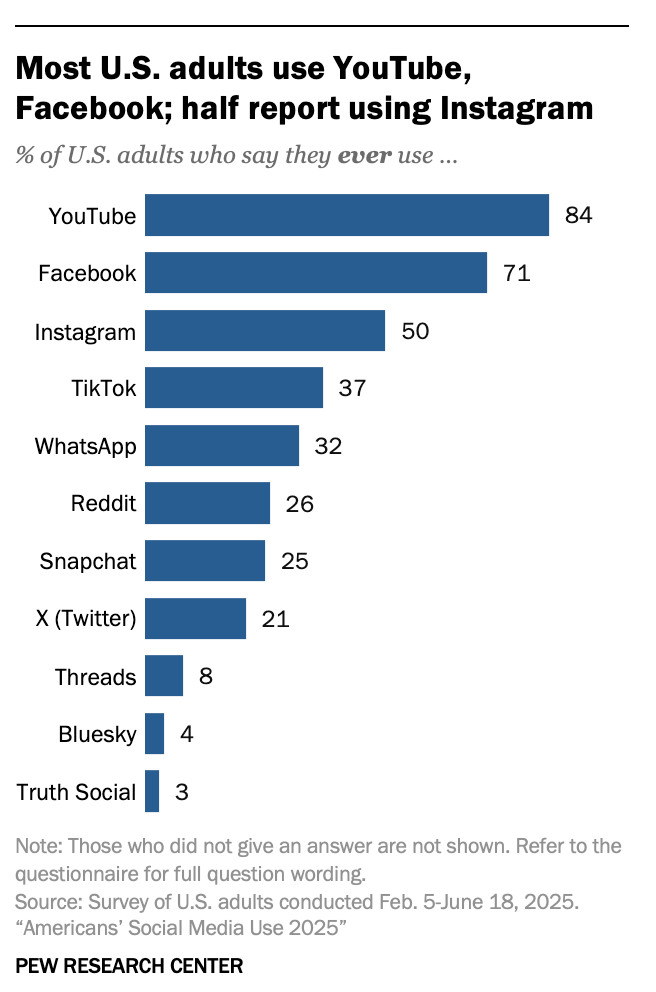
Recent survey data from over 5,000 U.S. adults shows YouTube (84%) and Facebook (71%) remain the most widely used platforms, with Instagram hitting the 50% mark. But the real story is generational: 80% of adults under 30 use Instagram, compared to just 19% of those 65 and older. TikTok, Instagram, WhatsApp, and Reddit have all grown since 2021, while YouTube and Facebook usage has stayed stable.
For marketers, this means your audience segmentation strategy needs to account for dramatic platform preferences by age, gender, education, and political affiliation. If you’re still treating “social media marketing” as one monolithic channel, you’re missing the nuance that drives actual engagement.
Read the full report from pewresearch.org ➞
That segmentation challenge extends beyond social platforms into how search engines themselves are evolving.
➞ Google Defends Its “Parasite SEO” Crackdown Amid EU Investigation
Google is now facing a European Commission investigation over its March 2024 policy update targeting “site reputation abuse”, the practice where scammers pay trusted publishers to host low-quality content and manipulate rankings. Google argues this pay-to-play tactic tricks both users and ranking systems, letting bad actors outrank legitimate sites. Examples include payday loan schemes appearing on reputable news sites or weight-loss pill spam hosted by educational domains.
Google maintains the policy protects users and levels the playing field for creators who don’t use deceptive tactics. A German court already dismissed a similar challenge, but the EU investigation continues. For site owners, the takeaway is clear: monetization strategies that rely on hosting third-party content for ranking benefits are now a compliance risk, not a revenue opportunity.
Read the full report from blog.google ➞
While Google refines its spam policies, another technical challenge is quietly undermining visibility in AI-powered search.
➞ LLM Crawlers Can’t Render JavaScript And That’s a Problem
A new industry survey reveals a troubling blind spot: as SEO conversations shift toward optimizing for AI Overviews and ChatGPT, many practitioners have forgotten that LLM crawlers cannot render client-side JavaScript. Unlike Googlebot, which can execute JavaScript to access dynamically loaded content, AI crawlers rely exclusively on text-based content in the initial HTML response.
This means fancy single-page applications and JavaScript-heavy sites are invisible to the very AI systems everyone is trying to optimize for. The fundamentals of technical SEO, server-side rendering, progressive enhancement, and ensuring core content loads without JavaScript are now more critical than ever. If your content requires JavaScript to display, it doesn’t exist for AI search engines.
Read the full report from sitebulb.com ➞
Technical rendering isn’t the only challenge for international sites; content strategy across languages is becoming just as complex.
➞ Build Topical Authority in Every Language, Not Just Your Main Market
AI search engines don’t respect hreflang tags or language targeting the way traditional search does. A striking experiment showed ChatGPT frequently pulled answers from an English site with minimal content, translated them into German, and served them to German-speaking users, even though a comprehensive German version existed. This breaks the old international SEO model where you could invest heavily in one primary market and maintain lighter versions elsewhere.
To measure cross-language authority, compare page counts, traffic, content depth, and bot crawl patterns across all language versions. Look for structural inconsistencies; one language might have clean internal linking while another has gaps from inconsistent translations. The goal isn’t identical content everywhere, but parallel topical hubs with sufficient depth to demonstrate expertise in each market you serve.
Read the full report from oncrawl.com ➞
The question then becomes: Does translating your content actually improve visibility in AI search results?
➞ Translated Sites Get 327% More AI Overview Citations
Analysis of 1.3 million citations across Spanish and English content reveals that translated websites achieve dramatically better visibility in Google AI Overviews. Untranslated Spanish sites received 431% more citations when users searched in Spanish versus English. But sites with proper translations closed that gap, gaining 327% more visibility in non-native language searches compared to untranslated competitors. ChatGPT showed virtually no language bias for translated sites, while AI Overviews still favored native-language content but cited translated sites far more often than untranslated ones.
The mechanism appears to be trust signaling; translation suggests authority and thoroughness to AI systems, improving performance across all languages. For international businesses, the cost of not translating is measurable: one Spanish book retailer in the study appeared 64% less often in English searches, and when cited, the link went to Google Translate’s proxy instead of their actual site.
Read the full report from weglot.com ➞
➞ From Google
Everything from Google search this week —
→ Google Search Console To Add Brand Query Filters (seroundtable.com)
→ Google Introduces Nano Banana Pro (blog.google)
→ Google Search with Gemini 3: Google’s most intelligent search yet (blog.google)
→ 6 new things you can do with AI in Google Photos (blog.google)
→ November Pixel Drop: ‘Wicked’ theme packs, Remix in Google Messages and more (blog.google)
→ NotebookLM adds Deep Research and support for more source types (blog.google)
→ Google wants AI dto o the hard parts of your holiday shopping (blog.google)
→ EU investigating Google over site reputation abuse policy (searchengineland.com)
→ More ways to share your shipping and returns policies with Google (developers.google.com)
→ Google Discover fixing fake AI spam problem (searchengineland.com)
→ Microsoft makes Clarity mandatory for Syndication Partner publishers (searchengineland.com)
➞ AI + Social
Find out what’s happening in the social media and artificial intelligence world —
→ Anthropic Introduces Claude Opus 4.5 (anthropic.com) - It’s intelligent, efficient, and the best model in the world for coding, agents, and computer use.
→ Streaming platform Twitch added to Australia’s teen social media ban (bbc.com) - Twitch, a streaming platform popular with gamers, has been added to Australia’s teen social media ban that starts next month.
→ Perplexity brings its AI browser Comet to Android (techcrunch.com) - The company is bringing most of the desktop version’s capabilities to Android.
→ Grok 4.1 is here (x.com) - Grok 4.1 isn’t just smarter, it’s sharper.
→ X inox is replaced by chat (X.com)
→ GPT-5.1: A smarter, more conversational ChatGPT (openai.com) - GPT‑5.1 Instant, ChatGPT’s most used model, is now warmer by default and more conversational.
→ Available now: GPT-5.1 in Microsoft Copilot Studio (microsoft.com)
→ ElevenLabs Announces Partnerships with Iconic Hollywood Actors (businesswire.com) - The announcements include new partnerships with Hollywood actors Michael Caine and Matthew McConaughey.
→ Genie 3 by Google DeepMind is insane. (x.com)
➞ Worth Reading
These are the articles that will help you refine your marketing knowledge —
→ Adobe to Acquire Semrush (news.adobe.com)
→ Cloudflare Resolves Global Outage That Disrupted ChatGPT, X (blog.cloudflare.com)
→ WORTH WATCHING: AI & Cybersecurity: Dan Boneh Interviews Sam Altman (youtube.com)
→ What If All Media is Marketing? (No Paywall) (dougshapiro.substack.com)
→ Inside ChatGPT’s GPT 5 Search: What the Configuration Files Reveal About How It Ranks Your Content (metehan.ai)
→ Use AI to Improve Content Audits (not perform them) (ianlurie.com)
→ How to Optimize Images for Visual Search & AI Overviews (semrush.com)
→ Google De-Indexed All of ChatGPT’s /share URLs — But the Gold Mine Still Exists (x.com)
→ Mastering GA4 Annotations: The Complete Guide for Marketers & Communicators (kpplaybook.com)
➞ What This All Means for Your Strategy
The throughline here is fragmentation; platforms, demographics, languages, and now rendering capabilities all require distinct strategies. The days of one-size-fits-all optimization are over.
Whether you’re deciding where to invest social ad spend, evaluating content partnerships, auditing your JavaScript dependencies, or expanding internationally, the question is the same: does your content reach the systems and audiences that matter to your business?
Start with one audit this week, pick the area where you suspect the biggest gap and measure what you’re actually leaving on the table.
Until next week,
Nishat from HighDegree* Marketing Newsletter
P.S. Have a question about implementing these strategies? Hit reply – we read every email and often feature reader questions in future issues.
➞ Who is Nishat Shahriyar?
I am a Digital Marketing Strategist, having worked in this field since 2007. Now working as a Product Marketing Lead at Fluent Forms (The best lead generation tool for WordPress), previously at Fluent Support (The best WordPress Helpdesk Plugin).
Connect with me, if you are not connected through my LinkedIn or follow me on X/Twitter - @rednishat